introducing topicspace intel
A new layer that turns a claim, basket, or ticker question into a grounded brief built from topicspace fields. Not a chatbot, not a recommendation engine — a layer for interrogating the field.
topicspace started as a way to track how narratives move across the AI and tech market.
But one problem kept showing up in practice. People do not just need a better dashboard. They need help answering a harder question:
What does the field actually support right now?
That is what topicspace intel is designed to do.

What intel is — and what it isn’t
Intel is a new topicspace layer that takes a claim, a basket of names, or a single ticker question and turns it into a structured brief grounded in topicspace fields.
Instead of asking users to interpret the full Board, every alert, every actor page, and every structure on their own, intel pulls the relevant context together and returns a clear read:
- what the claim is
- what supports it
- what pushes against it
- what the field currently says
- what the most important wrinkle is
- what to watch next
The goal is not to replace the rest of topicspace. The goal is to make the system easier to query.
Intel is not a recommendation engine. It is not trying to tell users what to buy, what to sell, how to size a position, or how to trade a one-day move.
It is also not a generic market chatbot. That distinction matters.
There are already plenty of tools that can generate plausible commentary. What they often cannot do is stay grounded in a specific field model, separate strong evidence from weak evidence, and handle partial coverage honestly. Intel is built to do that.
How it works
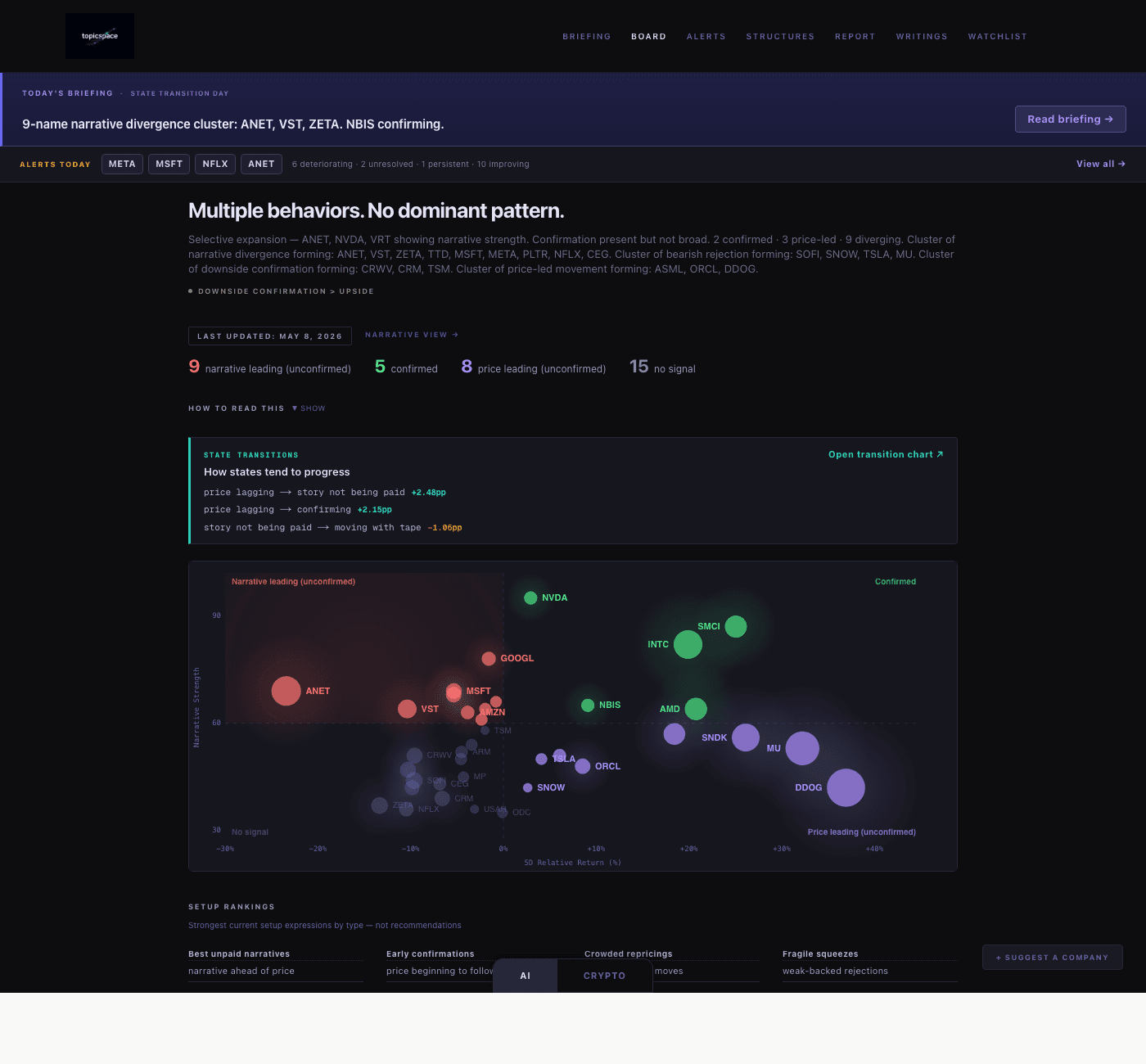
topicspace already produces structured fields across the product:
- story strength
- price behavior
- the gap between the story and the stock
- current state
- recent transitions
- reliability in context
- related alerts and daily field context
Intel uses those fields as its base layer. A user can bring in three kinds of requests.
1. check a claim
Example: “Is software rotating over semis?”
2. compare a basket
Example: “Compare MU, ADBE, CRM, TTD, and META.”
3. explain a ticker
Example: “What is actually going on with PLTR here?”
In each case, intel tries to answer the question using the same structured context that powers the rest of topicspace. That is what makes it different from a freeform LLM response.
What makes it different
A lot of market commentary fails in the same way: it collapses very different situations into one bucket.
A screen of “cheap AI stocks” may contain:
- one real contrarian opportunity
- one name where the market is already rejecting the bear case
- one price-led move that is already late
- and one stock that is cheap because the story is fading
Those are not the same trade.
The same is true for claims about rotation, earnings reactions, or sector leadership. One part of the claim may be supported. Another part may already be priced in. A third part may not show up in the field at all.
Intel is designed to make those differences visible.
The most important difference is that intel is built on top of a field model, not just a prompt. It is grounded in tracked actors, current state, recent changes, field-level context, structured signal labels, and explicit coverage.
That gives it a different shape than generic AI output. A good intel brief should be able to say things like:
- the claim is only partially supported
- the strongest support is in one part of the basket, not the whole thing
- the story is loud, but this kind of signal has been weak here
- the thesis is not contradicted, but it is absent from the field today
- this is a one-day price move, not yet a broader shift in the underlying story
That kind of distinction is where most of the value lives.
Why we built it this way
The backtesting changed how topicspace thinks about the product.
One of the clearest lessons from the research was that a strong story is not the same thing as a trustworthy signal.
The raw gap between the story and the stock mattered. But context mattered too. Some situations worked in one part of the market and failed in another. Some names looked strong but were historically weak in that context. Some moves were real, but already late.
Intel is a way to put that lesson into a more usable form.
Not just: what is strong? But: what does the data actually support, and what is missing from this framing?
Where it can be useful
Intel is especially useful when the market is noisy and fast-moving. That includes moments like:
- earnings reactions
- broad “rotation” claims
- valuation screens
- thematic baskets
- strong posts that flatten several names into one story
- names where the narrative and price are moving in opposite directions
It is also useful for reducing repetitive analysis. Instead of rebuilding the same reasoning path from scratch each time, users can ask the system for a grounded brief and then decide what to do with it.
The bigger direction
topicspace is still a product for AI and tech market analysis.
But intel points toward a broader product direction underneath that: not just more information, but better attention guidance.
The core idea is simple. When people are surrounded by too much noise, they need help deciding:
- what matters
- what is real
- what is weak
- what is still unconfirmed
- and what deserves monitoring now
Intel is one expression of that idea.
This is an early version, and it will get better as the field layer gets better. The goal is not to make intel sound impressive. The goal is to make it useful: grounded, honest about coverage, better at handling partial evidence, sharper about what supports a claim and what does not.
If topicspace is the system that tracks the field, intel is the layer that helps interrogate it.
A dashboard can show you what is happening.
Intel is meant to help answer a harder question: what does that actually mean here?
Follow the research
Occasional updates on Belief Stack, TopicSpace case studies, and runtime belief-state evaluation.
I'll send notes when there's a new spec, case study, methodology update, or major finding — not a weekly newsletter for the sake of it.